The Body

In this article, I will review the various possible complications, specifying for each one:
- whether this complication is common or rare,
- whether I have encountered it in my practice,
- and, above all, what can be done to reduce the risk of it occurring.
It is important to bear in mind that no surgical procedure is entirely risk-free. Every breast augmentation therefore carries potential complications, even though these are generally rare when the procedure is performed under the right conditions.
When considering this type of surgery, it is essential to accept this reality: a complication can always arise, even if every effort is made to prevent it.
If a patient feels overly anxious about these risks, I generally advise her to take more time to think it over. It is better to wait until she is fully ready and has accepted the possibility — however small — of a complication before going ahead with this type of procedure.
Infection
Infection is a possible complication following breast augmentation. It is generally slightly more common than in procedures such as liposuction or lipofilling.
The reason is simple: during breast augmentation, a foreign body—namely an implant—is introduced. However, any procedure involving a foreign body—such as a hip or knee replacement—naturally carries a slightly higher risk of infection.
How can the risk of infection be reduced?
At the Clinique Bellefontaine, several measures are in place to minimise this risk as much as possible:
- Antibiotic bath for the implant prior to insertion
- Antibiotics administered before the procedure
- Antibiotics after the operation, usually Augmentin 625 mg three times a day for a week (unless allergic)
- Very small incisions, usually between5 and 3.5 cm
- Use of the Keller Funnel, a device that allows the implant to be inserted with minimal contact, thereby reducing bacterial contamination
- Double gloving during the procedure to minimise the risk of infection
- Application of a protective dressing over the areolae, as this area may sometimes have secretions or hair, which slightly increases the risk of bacterial infection.
When does an infection occur?
When it does occur, infection generally appears between the 4th and 10th day after the operation. It is very rare for it to develop much later.
Initially, treatment involves extending or adjusting the course of antibiotics.
If, despite this, the infection progresses, it may unfortunately be necessary to remove the implant.
In this case, we generally wait between 3 and 5 months before a new breast augmentation can be performed.
It is important to note that removing an implant can be psychologically difficult for the patient, which is why every effort is made to avoid this situation.
What can the patient do to reduce the risk?
A very important factor is giving up smoking.
It is recommended that you stop smoking at least three weeks before the operation and for three weeks afterwards, as smoking can increase the risk of infection by five to six times.
How common is this complication?
Generally, the infection rate following breast augmentation is between 1% and 2%.
Thanks to the protocols in place at the Clinique Bellefontaine, our rate is below 1%. Despite all precautions, however, infections can still occur. In such cases, we always start with a course of antibiotics and, if necessary, remove the implants before replacing them with new ones a few months later.
Implant displacement (bottoming out)
Another possible complication following breast augmentation is the downward displacement of the implant, sometimes referred to as bottoming out.
Even when the implants are perfectly positioned during the procedure, they may shift in the weeks following the operation.
Bottoming out occurs when the implant drops too far down towards the lower part of the breast, which can alter the shape of the breast and give the impression that it sits lower than intended.
Why does this happen?
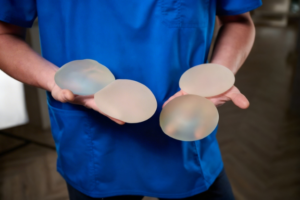
Nowadays, most of the implants we use are ultra-smooth implants such as Perle or Motiva implants.
These implants offer many advantages, but they also have a greater tendency to slip downwards in the first few weeks, whilst the tissue around the implant has not yet healed.
To minimise this risk, during the procedure we place absorbable sutures in the inframammary fold using PDS 2.0 suture material.
These sutures hold the implant in place whilst internal healing takes place, allowing the tissues to subsequently stabilise the implant permanently.
The importance of following post-operative instructions
Following post-operative instructions is essential to prevent the implants from shifting.
For example:
- do not sleep on your side for the first four weeks
- avoid raising your elbows above your shoulders for the first three weeks
- do not carry loads weighing more than one kilo for the first three weeks
If these recommendations are not followed, there is a risk of breaking the sutures placed to stabilise the implant, which may cause it to shift.
Is this a complication that has happened to me before?
Yes, this has happened to me in certain specific cases.
For example, I treated a young mother who, a week after the procedure, had to catch her little girl as she was about to fall. As she caught her, she felt a cracking sensation in her chest.
At the follow-up, everything seemed normal, but I had explained that there was a risk that one of the internal sutures might have snapped. Sure enough, a few weeks later, the implant had shifted downwards by a few millimetres.
In another case, a patient had very little solid tissue around the pectoral muscle, which made securing the internal sutures more difficult. In this situation, one implant had slipped slightly lower on one side than the other.
What should be done in the event of bottoming out?
When implant displacement is observed, we generally wait around six months after the procedure before considering a correction.
Periprosthetic capsule (capsular contracture)
Another possible complication following breast augmentation is what is known as a periprosthetic capsule, also referred to as capsular contracture.
When a foreign body is introduced into the body — such as a breast implant — the body reacts naturally by forming a thin layer of tissue around the implant.
This reaction is entirely normal and even desirable: this capsule helps to stabilise the implant. After around two months, once this layer is fully formed, the implant generally remains securely in place.
However, in some cases, this capsule can thicken abnormally and contract around the implant. This can cause:
- an increase in breast firmness
- a distortion of the breast
- sometimes pain
In this situation, the condition is referred to as capsular contracture.
If this is a significant aesthetic concern for the patient, a further surgical procedure may be performed to re-secure the inframammary fold and correctly reposition the implant.
The Baker scale
Capsular contracture is classified according to the Baker scale, which has four grades:
- Grade 1: the breast is supple and looks natural. The capsule may only be visible on ultrasound.
- Grade 2: the breast becomes slightly firmer, but its appearance remains normal.
- Grade 3: the breast is noticeably firmer and begins to show visible distortion.
- Grade 4: the breast is hard, painful and visibly deformed.
What are the risk factors?
Several factors can contribute to the development of a capsular contracture:
- significant bleeding after the procedure
- the presence of a seroma (fluid build-up)
- certain late-onset infections
- smoking
Historically, certain textured implants, particularly teardrop-shaped anatomical implants, could also increase inflammation around the implant and thus the risk of capsular contracture.
Today, we mainly use ultra-smooth implants featuring nanotechnology, such as those from Perle or Motiva. These implants carry a significantly lower risk of developing a capsule.
Furthermore, the risk is generally lower when the implant is placed behind the pectoral muscle, which is the case with the Dual Plane technique, which we usually use.
How is the diagnosis made?
If capsular contracture is suspected, the following is usually carried out:
- an ultrasound scan
- sometimes an MRI
These tests help to confirm the diagnosis and assess the degree of capsular contracture.
What should be done if capsular contracture is diagnosed?
The course of action depends on the level of discomfort experienced by the patient.
If the breast is simply a little firmer but without any distortion or pain, it is often preferable not to operate again.
However, when capsular contracture causes visible distortion or significant pain, treatment generally involves:
- removing the capsule (capsulectomy)
- replacing the implants
It is also important to note that, in many cases, no specific cause is identified for the development of capsular contracture.
As a general rule, the rate of capsular contracture following breast augmentation with implants is between 5 and 10 per cent. With the latest generation of ultra-smooth implants, such as Motiva or Perle, the rates currently reported appear to be between 0 and 4 per cent. In my practice, however, the reoperation rate for true severe capsular contracture remains below 1%, i.e. for Baker grade 3 to 4 contractures requiring further surgery.
Bleeding and bruising
Following breast augmentation, it is normal for patients to experience bruising (ecchymoses) or small haematomas. This is part of the normal post-operative recovery process and generally fades gradually in the days or weeks following the procedure.
When the implant is placed behind the pectoral muscle, there may also be a temporary difference in volume between the two breasts post-operatively, sometimes as much as 30 to 40% difference. In most cases, this is simply due to oedema or minor localised bleeding that resolves spontaneously.

When do we refer to a true haematoma?
In some rarer cases, more significant bleeding may occur. Blood may then accumulate around the implant, causing:
- a rapid increase in breast volume
- sometimes a breast that can almost double in size
- significant tension, often more pronounced in the upper part of the breast
In this situation, it is necessary to operate again quickly in order to:
- drain the haematoma
- to stop the bleeding
- and then reposition the implant correctly
The importance of the surgical approach
In my practice, I believe that the inframammary approach (in the crease beneath the breast) helps to reduce the risk of bleeding and bruising.
This approach does indeed offer better control of bleeding during the procedure compared to other techniques, such as the axillary (under the armpit) or areolar approach.
Furthermore, when bleeding occurs following a breast augmentation performed via the axillary or areolar approach, it is often necessary to make an incision in the inframammary fold in order to control the bleeding properly.
With current techniques, inframammary scars are generally very small (between 2.5 and 3.5 cm) and well concealed in the breast crease, making this a safe and aesthetically pleasing option.
Is this a complication I have encountered before?
Yes, but it remains very rare in my practice.
To date, it has only happened to me once. It involved a patient who, around 13 days after the operation, made a sudden, awkward movement with her arm. Shortly afterwards, her breast began to swell.
An ultrasound scan showed that a small bleed had occurred following a tear in a muscle of the chest wall, probably caused by this sudden movement.
This type of situation is very unusual, as the vast majority of bleeds occur within the first 24 hours after the procedure, not several days later.
Implant rupture
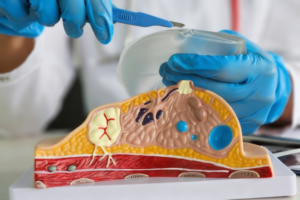
Another possible complication following breast augmentation is implant rupture.
Like any medical device implanted in the body, breast implants can wear out over time. The longer an implant remains in the body, the greater the risk that the material will weaken or deteriorate, which can lead to rupture.
Should implants be replaced regularly?
For a long time, it was recommended to replace implants every 10 to 15 years to prevent this type of complication.
Today, in Switzerland, the SSCPRE (Swiss Society of Plastic, Reconstructive and Aesthetic Surgery) no longer recommends replacing them systematically every 10 to 15 years. Implants are generally replaced only if a problem arises, for example:
- implant rupture
- capsular contracture (capsule formation)
- implant displacement
- aesthetic or functional discomfort
In the absence of complications, it is therefore not mandatory to replace implants after a certain number of years.
How can an implant rupture be detected?
In many cases, an implant rupture may be silent, i.e. without any obvious symptoms.
To check the integrity of an implant, the following is usually carried out:
- a breast ultrasound, which often detects signs of rupture
- an MRI scan, if there are still concerns after the ultrasound
The two types of rupture
There are generally two types of implant rupture:
Intracapsular rupture
A few weeks after the operation, a fibrous capsule naturally forms around the implant. If the implant ruptures but the silicone gel remains contained within this capsule, this is referred to as an intracapsular rupture.
Extracapsular rupture
If the fibrous capsule is also ruptured, the silicone can migrate outside the capsule and sometimes form small nodules called silicomes in the surrounding tissue.
My personal experience
In my practice, I have treated several patients with implant ruptures, but in the majority of cases these were patients whom I had not originally operated on.
For example, some patients had saline implants (filled with saline solution). In such cases, when the implant ruptures, the breast rapidly loses volume as the fluid is absorbed by the body. We therefore generally replace these implants with modern silicone gel-filled implants. It is worth noting that saline implants are now rarely used in Switzerland.
In other situations, I have treated patients who received substandard implants, often following procedures carried out abroad in ‘low-cost’ clinics. These implants can sometimes rupture relatively early.
In such cases, the treatment involves:
- removing the ruptured implant
- cleaning the implant pocket
- then inserting a new implant
Generally, when replacing an implant, it is preferable to use one of an equivalent size or slightly larger, in order to properly support the tissue and prevent the breast from sagging.
If the patient wishes to have a smaller implant or no longer wishes to have an implant at all, it is often necessary to combine the procedure with a breast lift to restore a harmonious shape to the breast.
Rotation of anatomical implants
Another possible complication that affects only anatomical implants is rotation.
Unlike round implants, anatomical implants have a specific shape that must remain in a precise position to maintain the natural appearance of the breast. If the implant rotates within the pocket where it has been placed, the shape of the breast may be altered and become asymmetrical.
Features of anatomical implants
To reduce the risk of rotation, anatomical implants are textured, which allows the implant to adhere better to the surrounding tissue.
However, this texture can also have certain drawbacks. Textured implants may be associated with:
- a slightly higher risk of capsular contracture (capsule formation)
- a very rare risk of implant-associated anaplastic large cell lymphoma (BIA-ALCL)
For these reasons, some countries have taken specific measures. For example, textured anatomical implants have been banned in France since 2019.
In Switzerland, they remain authorised, as in most European countries. The key point is that patients are properly informed of the benefits and risks before the procedure.
When can rotation occur?
When it does occur, rotation of an anatomical implant most often happens in the first few weeks after surgery, before scar tissue has stabilised the implant.
Several factors can contribute to this rotation:
- a surgical pocket that is too large around the implant
- failure to follow post-operative instructions
- failure to wear the post-operative bra correctly, which helps to stabilise the implants during the healing phase
After around eight weeks, a fibrous capsule forms around the implant. This capsule generally helps to keep the implant in place and significantly reduces the risk of rotation.
How common is this complication?
A slight rotation of anatomical implants can be observed relatively frequently, in around 10% of cases, but it is often subtle and has no significant aesthetic consequences.
However, a complete 180-degree rotation results in a noticeable change in the shape of the breast.
What should be done in the event of significant rotation?
When significant rotation occurs and clearly alters the shape of the breast, further surgery may be necessary.
In such cases, the anatomical implant is usually replaced with a round implant, which permanently eliminates the risk of rotation.
My personal experience
In my practice, I observe that around 10% of patients experience slight rotation of anatomical implants post-operatively.
However, these are usually minimal rotations, which do not result in any significant aesthetic consequences and do not require further surgery.
On the other hand, I have treated a few patients who had surgery at other centres, where the situation was more pronounced. To date, I have encountered two cases of complete 180-degree rotation.
In these situations, the breast deformity was obvious, and it was necessary to remove the anatomical implant and replace it with a round implant to prevent any recurrence.
Rippling or implant undulation
Another possible complication following breast augmentation is what is known as rippling, i.e. the appearance of visible waves or folds in the implant beneath the skin.
These ripples may be particularly visible in the upper part of the breast, but can also sometimes be seen in the lower part of the breast.
Why does rippling occur?
Rippling generally occurs when the layer of tissue covering the implant is relatively thin.
This can occur in a number of situations:
- in patients who had little breast tissue and fat in the chest area prior to the procedure
- in patients who lose weight after breast augmentation, which reduces the layer of fat covering the implant
When this protective layer becomes thinner, the natural folds of the implant may become visible or palpable beneath the skin.
How can rippling be corrected?
When it becomes aesthetically unsightly, rippling can be corrected using lipofilling, i.e. a fat injection.
This technique involves:
- removing fat from another area of the body (stomach, thighs, hips)
- purifying it
- then injecting it around the implant
This increases the thickness of the fat layer above the implant, making the rippling much less visible.
Is this a complication I have encountered before?
Yes, I have observed this phenomenon in my practice.
In most cases, these were patients who had lost weight following their breast augmentation, which had reduced the thickness of the tissue covering the implant.
The ripples were not always very visible, but some patients wished to have them corrected to improve the aesthetic appearance.
In these situations, lipofilling generally produces very good results and makes the ripples much less visible.
Changes in breast sensitivity
After a breast augmentation, some patients may experience changes in sensitivity in the breast or around the areolae.
These changes are usually temporary and are due to the fact that the tissues and small sensory nerves are stretched during the procedure.
Impact of the surgical approach
In my practice, I perform the vast majority of breast augmentations via the inframammary approach, i.e. through an incision in the crease beneath the breast.
This technique generally allows for better preservation of the breast’s sensory nerves, which reduces the risk of lasting changes in sensitivity.
However, some patients may experience a temporary reduction in sensitivity in the lower part of the breast. In the vast majority of cases, this sensitivity gradually returns in the months following the procedure.
To date, in my practice, I have never observed any permanent loss of sensitivity in the areolae or the breast.
Specific features of the areolar approach
For surgeons who perform breast augmentation via an incision around the areola, the risk of changes in sensitivity may be higher.
In this case, two situations may arise:
- a decrease in sensitivity
- or, conversely, hypersensitivity of the areola
This approach has the advantage of leaving very discreet scars, but it also has certain disadvantages.
In particular, it may:
- slightly increase the risk of infection,
- alter the sensitivity of the areola,
- and, in some patients, reduce the chances of being able to breastfeed later on, as some milk ducts may be severed during the procedure.
For these reasons, I generally prefer the inframammary approach, which I believe strikes a good balance between surgical safety and aesthetic results.
Pneumothorax
Pneumothorax is a very rare complication that can occur during breast augmentation.
This is a situation in which a tear occurs in the pleura, the thin membrane surrounding the lungs. When this happens, air can accumulate around the lung, which may cause it to partially collapse.
When can this happen?
In the context of breast augmentation, this type of complication can theoretically occur when creating the pocket behind the pectoral muscle, if the surgeon gets too close to the ribcage.
Fortunately, this remains extremely rare.
How is a pneumothorax treated?
Treatment depends on the severity of the pneumothorax.
In mild cases, simple medical monitoring may be sufficient, as the air sometimes resolves spontaneously.
In more severe cases, it may be necessary to perform a chest drain, i.e. inserting a small tube to remove the air and allow the lung to re-expand properly.
My personal experience
In my practice, I have never yet encountered this complication.
This is consistent with what is observed in the scientific literature: pneumothorax following breast augmentation remains a rare occurrence.
Breast Implant-Associated Anaplastic Large Cell Lymphoma (BIA-ALCL)
Breast implant-associated anaplastic large cell lymphoma, known as BIA-ALCL, is an extremely rare complication that can occur following breast augmentation.
It is important to note that this is not breast cancer. This condition is a lymphoma, i.e. a cancer of the immune system that develops in the capsule surrounding the implant, and not in the breast gland itself.
Which implants are affected?
To date, the cases described have been observed exclusively in patients with textured implants.
These implants include, in particular:
- anatomical (teardrop-shaped) implants
- certain older-generation textured round implants
Today, many surgeons mainly use ultra-smooth implants featuring nanotechnology, which reduces this risk.
What approach should be taken for patients with textured implants?
For patients who already have textured implants, current guidelines do not recommend removing the implants as a preventive measure.
It is simply recommended to remain vigilant for certain signs, in particular:
- a sudden increase in breast size
- the presence of fluid around the implant
- swollen lymph nodes in the armpits
If in doubt, it is advisable to consult a doctor for a clinical examination and, if necessary, an ultrasound scan.
Regulatory situation
In France, textured breast implants have been banned since 2019.
In Switzerland, as in most European countries, they remain authorised, as the risk of BIA-ALCL is considered very low. The key point is that patients must be properly informed of this risk before the procedure, so that they can make an informed decision.
How common is this complication?
According to Swissmedic data, 21 cases were recorded in Switzerland between 2012 and the end of July 2024.
The estimated risk for patients with textured implants is thought to be around 1 in 30,000.
My personal experience
In my practice, I have never yet had a patient presenting with this type of complication.
This is consistent with the available statistics, as it is an extremely rare occurrence.
Conclusion
I hope this article has helped you better understand the possible complications following breast augmentation.
My aim was to present my own experiences of complications in a transparent and honest manner, explaining those I have encountered in my practice and those which, fortunately, remain very rare.
It is important to remember that the vast majority of breast augmentations proceed without complications, but as with any surgical procedure, certain risks do exist. Being well-informed allows you to make a considered and confident decision.
If you are considering breast augmentation and still have questions, I hope this article has already provided some useful answers.
Kind regards,
Dr Yann Favre